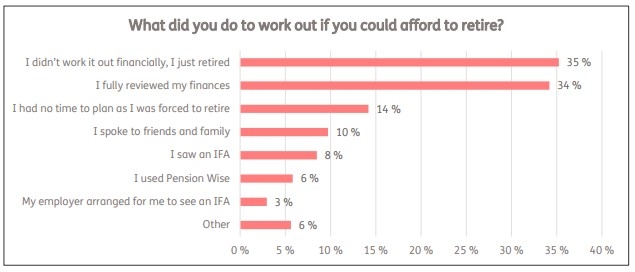
Half (49%) of retirees entered retirement without any clear financial plan for their post-work years, according to a new report.
Over a third (35%) of retirees over 55 surveyed by Just Group said they retired without making any financial assessment of their ability to afford retirement.
A further 14% were forced to retire earlier than expected and said they “ran out of time” to make financial plans.
Less than one in 10 (8%) retirees sought the help of an independent financial adviser.
Stephen Lowe, group communications director at retirement specialist Just Group, said: “Receiving financial advice remains the gold standard for preparing financial plans ahead of retirement and, if possible, we’d encourage people to explore this option.
“It may be that your employer offers help, perhaps by making an introduction to a recommended IFA or even making a financial contribution towards the cost – so do check with them. The advent of the digital world means there are some lower cost online and hybrid solutions available for guidance or advice.
“At the very least people should make sure they take up their entitlement to use Pension Wise – the Government backed, independent and impartial service which provides free pension guidance.”
{loadposition hidden2}
Just 6% of those surveyed by Just said that they had used Pension Wise.
Some people took a DIY approach and made their own calculations with over a third (34%) saying that they had conducted a full review of their savings looking at their likely incomings and outgoings.
A further 10% said that they had spoken with their friends and family for informal help and 6% had used other sources of support.
• Just Group surveyed 1,050 UK adults over 55 between 17 and 27 August.
{loadmoduleid 444}
]]>
The charges on the most expensive tracker funds are 20 times the cost of the cheapest alternative despite identical or near identical performance, according to new research by investment platform AJ Bell.
The company says that investors could be paying,”far more than necessary” for tracker funds.
AJ Bell says that an investor with £10,000 in the most expensive UK stock market tracker, for example, pays £106 in investment management fees every year but could cut that to just £5 with the cheapest tracker fund.
AJ Bell’s calculations suggest that holding the cheapest tracker could leave the investor with a portfolio worth £19,580 after a decade, but just £17,807 if they invested in the priciest instead - a difference of nearly £1,800 even though both funds deliver identical performance.
{loadposition hidden2}
An investor holding a mixed tracker portfolio across seven of the main investment sectors covering global equity markets could be almost £9,000 better off over 10 years, based on a £100,000 investment, AJ Bell calculated.
The most expensive tracker funds are often at least 0.2% more expensive than the cheapest option, according to the firm's research. In some cases they can cost 0.5% or even 1% more than the lowest price alternative tracking the same region.
Tracker Charge Differences
|
|
Most expensive |
Average |
Cheapest |
|
Asia Pac ex Jap |
0.32% |
0.18% |
0.11% |
|
Europe ex UK |
0.13% |
0.12% |
0.06% |
|
Global |
0.62% |
0.14% |
0.12% |
|
Global EM |
0.41% |
0.24% |
0.20% |
|
Japan |
0.31% |
0.15% |
0.08% |
|
North America |
0.30% |
0.10% |
0.05% |
|
UK |
1.06% |
0.16% |
0.05% |
Source: AJ Bell/Morningstar
AJ Bell says that while some of the most expensive trackers may have first been purchased by investors some time ago - and could originally have been priced with an ‘all-in’ fee covering investment, administration and any financial advice received at the time - many of these funds have now been moved to a modern investment platform where it is likely investors could switch to cheaper funds.
One issue is that current rules mean that, were investment platforms to notify investors about possible cost savings on passive holdings in their portfolio, they may be deemed to have provided financial advice, AJ Bell says.
The current FCA Advice Guidance Boundary Review is considering ways to improve the help customers receive and the company believes this is one area where a relaxation of the rules around what constitutes a personal recommendation could lead to better consumer outcomes.
AJ Bell, head of investment analysis, Laith Khalaf, said: “It might come as a surprise, but not all tracker funds are created equal.
“There can be a big gulf in charges, and over time this can produce a seriously large dent in nest eggs if you happen to be invested in a higher cost tracker. With no chance of outperformance because they invest passively, the difference in returns between comparable tracker funds will be largely dictated by fees. It therefore makes sense for investors to seek to reduce costs where possible.
“At the moment, platform providers can identify customers who hold higher cost tracker funds, but can’t contact them to point this out as this could constitute personal financial advice. The regulator is currently reviewing the dividing line between advice and guidance, and this is an example of how relaxing the rules could help investors to make better, more informed decisions.”
{loadmoduleid 444}
]]>
The number of UK adults with Private Medical Insurance has risen by 1m in the past five years to reach 6.9m, according to analysis of the FCA’s Financial Lives survey by consultancy Broadstone.
The ongoing problems in the NHS are believed to have spurred the surge in sales, particularly in the employee benefits sector.
An estimated 13% of UK adults hold health insurance rising to 18% among the employed.
Nearly one in five employees are now covered by private medical insurance.
{loadposition hidden2}
Three-quarters (76%) of those with PMI hold it as part of an employee benefits package with around a fifth (19%) of workers self-funding. The age groups with the highest level of coverage were those aged 35-44 and 45-54, with 22% of each group holding PMI.
Independent consultancy Broadstone predicts that the number of people taking out Private Medical Insurance (PMI) will continue to rise with more businesses set to take out policies to support the health of their employees.
Brett Hill, Broadstone head of health and protection, said: “The FCA’s research paints a helpful portrait of the PMI sector and shows its importance as an employee benefit with coverage concentrated among working adults.
“Given the crisis in the NHS and the surging levels of economic inactivity due to chronic illness, we expect growth in coverage of PMI to continue, and most likely accelerate, in its current upwards trajectory.”
Broadstone says that the latest update from the Private Health Information Network (PHIN) reveals that private health admissions surged in 2022 and recorded the largest ever quarterly total of admissions in Q1 2023 (227,000), largely driven by increases in insured treatments.
{loadmoduleid 444}
]]>
A third (32%) of Britons rank pension planning as their lowest 'life admin' priority, according to research from Standard Life.
They saw planning for retirement as a less important part of their ‘life admin’ than managing hair appointments and planning holidays.
Almost a quarter (22%) of those who were saving for a pension said they did not check their pension annually as they do not know what they should be doing.
Some 14% said they never checked their pensions.
One in seven (16%) said they do not know where to access their pension information.
Separate research from Hargreaves Lansdown found that nearly a third of investors (30%) wished they had focused more on their pension savings.
Hal Cook, senior investment analyst at Hargreaves Lansdown, said: “One in 10 retirees say they regret not looking more closely at their investments while saving, with a further 22% wish that they had got to grips with pension saving earlier. This, coupled with the fact that 55% of respondents don’t know how their pension investments are performing, highlights the lack of interest that people seem to have for their retirement financial planning.
“The reality for most is that retirement seems so far away it becomes the thing you keep pushing down your 'to do' list – something you will look at tomorrow, rather than making it a priority with today’s jobs. This present bias can result in lower retirement savings.”
{loadposition hidden2}
A third research report from Aviva found that millions of 32 to 40-year-olds auto-enrolled into their default pension scheme never update their contributions, investment choices or target retirement age.
More than half of those on middle incomes due to retire in the 2050s told Aviva they had either never heard of, or know anything about, their retirement options.
Some 6% said they think they would need less than £15,000 a year to achieve a minimum standard of living in retirement, and 9% said that they would would take their whole pension pot as cash at retirement, leaving them with the possibility of a large tax bill and a substantial risk that they would run out of money in later life.
Only one in five (19%) said they felt prepared in terms of how they will fund their retirement.
Just one in ten of those on middle incomes retiring in the 2050s surveyed by Aviva had taken professional advice, in comparison to 37% of the same cohort in the USA.
• Aviva surveyed 3,000 adults between 18 and 75 from across the UK in March. Standard Life and Opinium conducted researched 2,000 UK adults between 29 August and 1 September and Opinium surveyed 2,000 UK pension savers on behalf of Hargreaves Lansdown in May.
{loadmoduleid 444}
]]>
Retirees worldwide will outlive their savings by a decade and women will fare even worse on average, according to a report from respected thinktank the World Economic Forum.
The WEF warns that because of “strained government and employee retirement plans” many pension savers are finding it difficult to save enough for retirement.
The WEF, a Geneva-based organisation which organises the annual Davos conference, says retirees in six major world economies could expect to outlive their savings by eight to nearly 20 years on average.
Women and Japanese retirees will outlive their savings for longest. Life expectancy in Japan is one of the longest in the world.
The forum has called on individuals and policy-makers to take steps to ensure individual retirement investments can provide returns retirees “won’t outlive.”
{loadposition hidden2}
Experts at the forum say that savings have not accelerated fast enough to make up for the deterioration of traditional retirement plans.
The new report by the World Economic Forum, Investing In (and for) Our Future looked at six mature world economies: Australia, Canada, Japan, the Netherlands, the United Kingdom and the US.
It found that in these economies, most male retirees can expect to live past their savings by nearly a decade and women can expect to live even longer without their savings and typically more than 10 years.
The shortfalls vary with men in the United States expected to outlive their savings by about eight years while women in Japan will live nearly 20 years past their savings account.
The forum warns: “The average retiree in Australia, Canada, Japan, the Netherlands, the United Kingdom, or the US will not be able to last through retirement on savings alone.”
To help tackle the changes the WEF says government should encourage a long term savings ‘mindset’ and take appropriate risk to ensure savings grow.
It says many people are “…far too risk-averse in their retirement investing.”
Pension savings should also be better diversified to mitigate overall investment risk with exposure to most of the assets classes and not just equities.
“Sound financial advice,” is important, says the forum.
There is also a growing awareness globally of the value of robust decumulation strategies, says the forum.
The forum says: “For instance, today’s retirement spending projections are based on the rule that retirees will withdraw 4% of their portfolio each year they are retired. However, the World Economic Forum and Mercer suggest that this estimate does not match how retirees spend in the real world, with much higher spending in early retirement years and less as retirees age.
“This spending volatility highlights the need for new retirement solutions that both allow for flexible spending while also ensuring savings that last through retirement.
Rich Nuzum, president of Wealth at Mercer, said: “With populations around the world living longer than ever before, we need far more creative decumulation solutions for longevity protection.
“There are some alternative solutions emerging, such as pooled annuity funds, but older individuals are going to need a more diverse range of financial tools to help protect against longevity risk.”
{loadmoduleid 421}
]]>

The Chartered Insurance Institute (CII) has launched a new ‘Our History”’ website dedicated to bringing to life the heritage of the organisation and the evolution of the insurance profession over the years.
The website - insurancehistory.cii.co.uk - covers the history of the institute’s Aldermanbury building, including a 360-degree virtual tour of the Insurance Hall and displays the unique stained-glass windows of the historic building.
The CII’s collection of more than 1,500 Fire Marks, which were formerly on display in the staircase of the Aldermanbury building, can be viewed on the site.
{loadposition hidden2}
There are also digitised versions of hundreds of insurance-related documents, dating back as far as 1669, plus rare, no longer in print books, that give valuable insight into past insurance processes.
The original 1912 Charter of the Chartered Insurance Institute can also be found on the site.
Sian Fisher, chief executive of the Chartered Insurance Institute, said: “We want everyone to be able to appreciate the heritage of the insurance profession and now everybody from around the world can learn more about the history of the Aldermanbury building, insurance and the CII as an institution.”
{loadmodule mod_acymailing,Daily Newsletter Sign-up}
]]>
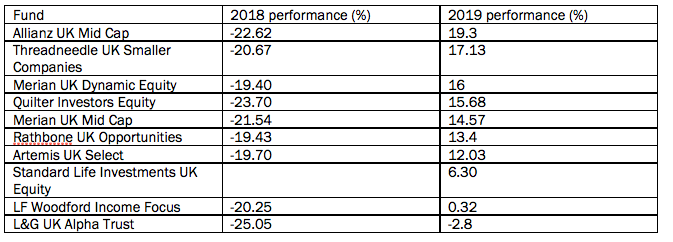
New research from Willis Owen has revealed that eight of the worst-performing UK ‘dog’ funds of 2018 experienced a “significant” rebound of up to 19% this year.
The analysis, which looked at funds in the Investment Association’s UK sectors, found that Allianz UK Mid Cap was the third worst-performing fund in 2018, returning -23%, but had bounced back by 19% since the start of 2019 to 31 May.
Threadneedle UK Smaller Companies was the second biggest gainer ahead of Merian UK Dynamic Equity in third place, boasting returns of 17% and 16% respectively in 2019 recovering from -21% and -19% the year before.
Even Neil Woodford, who has recently suspended his UK Equity Income Fund, experienced a modest uptick in performance of 0.32% this year with the LF Woodford Income Focus fund – up from -20%.
{loadposition hidden2}
Adrian Lowcock, head of personal investments at Willis Owen, said: “It is interesting to see the LF Woodford Income Focus Fund appear in the list.
“This is the version without all the unlisted equity, being more of a core equity income portfolio.
“It shows that Woodford’s performance woes are not only due to holding unlisted stocks.
“Whilst Woodford’s view on the British economy have largely been accurate, the fund’s positioning has suffered when we reached high levels of Brexit uncertainty, such as in December and again this May, when Theresa May announced her resignation.”
He added: “The worst performers tended to invest in the more volatile, riskier mid-cap and smaller companies and have unconstrained portfolios that do not follow benchmarks.
“These types of funds are likely to suffer more in sell-offs driven by short-term changes in sentiment as investors sell first and ask questions later.
“The trigger for the recovery is different for each fund.
“For example, Merian UK Mid Cap is focused on some of the UK’s most exciting growth companies, which suffered from profit-taking last year as investors became risk adverse.
“But as risk came back on the table, the fund recovered some but not all their losses.”
{loadmodule mod_acymailing,Daily Newsletter Sign-up}
]]>
Financial Planners are increasingly turning to technological solutions to help them better engage with clients or run their business more effectively.
One planner who has observed and adapted to this march of technology is Marlene Outrim FCSI Certified Financial Planner and Chartered Wealth Manager and managing director of Cardiff-based UNIQ Family Wealth.
Ms Outrim looked at this in-depth in an exclusive article in the latest issue of Financial Planning Today.
Here she explains how Financial Planners can make technology work for them.
I’m no techie but I know technology is advancing at breakneck speed.
These days computers fit in our pockets, businesses live in the cloud and we can meet face to face without leaving the office.
{loadposition hidden2}
But technology is a tool – it should work for us, not the other way around.
I’ve always embraced anything that makes things quicker, smarter and better for us and our clients.
When I first set up in the ‘90s, people still used MS-DOS.
I tried lots of different back office setups and while some fell by the wayside, others discharged their duties with honour, like Prestwood Cashflow software (which I still use today).
As time went on, we moved to a paperless model, mostly to stop paying for filing space.
At the time we used Watermark, but things move on and these days you can just use a scanner or there are smartphone apps that do almost as good a job.
By 2013 when I set up UNIQ Family Wealth things had moved on dramatically.
I wanted to embrace the aspects of technology that would make the business run as smoothly and efficiently as possible.
A clean sheet of paper – albeit a digital one.
These days we run the whole business on Microsoft 365 and we use the tasking system for workload planning.
Everything is cloud based, which gives us physical space to move and peace of mind.
We also use Voice over Internet Protocol (VOIP), which means we’ve been able to add lines for our remote office and use the phones on our mobiles at no extra cost.
We spent a long time finding the right back office system and settled on FinPlan.
It hasn’t been without its teething problems but it’s quick, gives us access to great data, puts workflows
in place for every member of the team and we can be sure every step of the process is being
completed.
It has a client portal and we can send and log emails and texts automatically for things like appointment reminders.
We can handle fees and commission reconciliation more quickly and it also gathers the reporting
information we need for Gabriel.
The other big accounting development is Xero.
It gives access to all the financial statements and figures I need within seconds.
Again, it comes down to the key question you should always ask yourself with any new technology, does it make things better?
It’s not just about the office. Technology has revolutionised the way we portray ourselves and we’ve reaped the benefits of digital marketing through my daughter, Laura Janes, our marketing director and head of marketing agency Uniquity.
We rebuilt our website and redefined our marketing strategy three years ago, going from no online leads to two a week.
From there, we brought in email sign-ups, slick, professional newsletters through Mailchimp and social scheduling through Buffer.
The list goes on and as we’ve expanded we’ve worked closely with QuicksmartIT, our IT partner.
Technology doesn’t just change the dynamic within a business, it changes the dynamic between businesses – processes become faster and better internally and between you and your partners.
Click here to read the full article for free in the latest issue of Financial Planning Today.
{loadmodule mod_acymailing,Daily Newsletter Sign-up}
]]>
Billionaires around the world saw their wealth increase in 2017 to a record £6.8 trillion held by 2,158 individuals.
Chinese entrepreneurs led the way as billionaires there added just over £1 trillion to their wealth in 2017, the greatest annual increase ever, according to a joint report from UBS and PwC.
Among other key findings:
• Chinese billionaires increased in number from 318 in 2016 to 373 in 2017. The growth rate in the Asia Pacific region was 32%;
• China created two new billionaires a week and Asia created more than three billionaires a week
• In the Americas, wealth increased slower than the global rate at 12% - to £2.17 trillion but this region still boasts the biggest wealth concentration from the tech industry by far
• Currency appreciation saw Western European billionaires’ wealth grow by 19% but the number of billionaires rose by just 4 per cent to 414
• 11% of billionaires worldwide are female
The report ,drawing on UBS and PWC’s worldwide client network and inhouse data, forecasts a major ‘wealth transition’ over the next 20 years as older billionaires die off and pass on wealth to the next generation.
{loadposition hidden2}

Source: UBS-PwC Billionaire Report
The findings were published today in UBS and PwC’s joint, Annual Billionaires Insights report: New Visionaries and the Chinese Century.
Josef Stadler, head of ultra high net worth at UBS Global Wealth Management, said: “China’s vast population, technology innovation and productivity growth combined with government support, are providing unprecedented opportunities for individuals not only to build businesses but also to change people’s lives for the better.”
“We are experiencing a new wave of entrepreneurship worldwide, with billionaires at the vanguard of innovation. They are creating jobs and prosperity, but their impact goes beyond economics.
“A new generation is emerging, and they see an opportunity to tackle some of the greatest environmental and societal challenges facing humankind.”
{loadmodule mod_acymailing,Daily Newsletter Sign-up}
]]>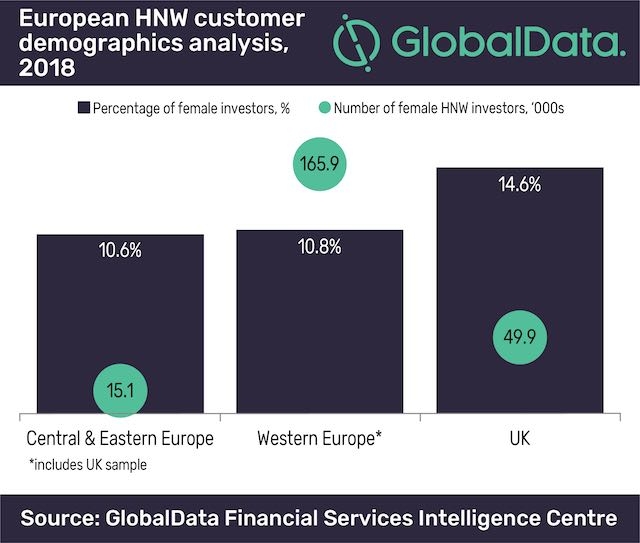
Almost 15% of UK HNW investors are women, equivalent to 50,000 individuals and the largest female HNW population in Europe, according to new research.
The UK is one of the few European markets in which women are a major segment forming 1 in 6 of all HNW investors, says GlobalData, a data and analytics company.
The UK has more female millionaires than in “all the nations of Central and Eastern Europe combined” - says GlobalData - and this demographic segment represents a growing opportunity for wealth managers to target a sector that is currently a poorly served segment.
The company’s report, ‘Wealth in the UK: HNW Investors 2018’, reveals that while it is already a mature wealth market, the UK has room for growth with expansion of intergenerational wealth transfer expected and a gap between inheritance and tax planning services and demand.
{loadposition hidden2}
Global Data says that propositions targeted at wealthy women can “prove to be a competitive advantage.”
However so far, globally the industry as a whole has “failed to connect” with women. Global Data say that in the UK specifically this is complicated by the fact that many wealthy women are busy executives, either entrepreneurs or high-flying employees.
Time constraints are a key problem for this demographic, something they share with male colleagues however, whereas British men can rely on their wealth managers to understand their needs to build up trust and facilitate a convenient relationship “wealthy women do not have that luxury.”
Bartosz Golba, head of content, wealth management at GlobalData, said: ‘‘Wealth managers that can connect with female investors on concerns such as dependents, financial health, and risk management will have a competitive edge in this large and growing segment.’’
“Being able to differentiate from other providers in the UK’s well-developed wealth management market is key. 55% of wealth managers surveyed by GlobalData agree that intergenerational transfers will be a big source of new business in the coming years. Hence inheritance planning will continue to be of importance, but competitors can stand out from the crowd by adding tax advice to the mix.
He added: ‘‘The industry also has to consider alternatives for discretionary asset management services traditionally favoured by HNW clients. Demand is increasing for both advisory mandates and automated solutions like robo-advisers – and UK wealth managers are worried. Those that can adapt to a hybrid model will gain market share.”
{loadmodule mod_acymailing,Daily Newsletter Sign-up}
]]>