Citizens Advice has criticised the FCA over its response to the so-called loyalty penalty super-complaint.
The charity called out the FCA over three areas, savings mortgages and home insurance.
On savings it said the regulator should “confirm its proposal to introduce a basic savings rate, which they estimate will save customers a net £300 million a year”.
And, on mortgages, it said: “The FCA should require firms to put vulnerable and low-income customers on to better value mortgage deals.”
{loadposition hidden2}
Ofcom was also criticised over mobile phone and broadband contracts.
Gillian Guy, chief executive of Citizens Advice, said: “We’re disappointed that a lack of action from regulators means customers continue to be penalised simply for being loyal to their provider.
“In its response to our super-complaint the CMA set out ambitious recommendations for tackling the loyalty penalty.
“But it seems little progress has been made by the regulators within the first six months.
“This is not good enough.
“The FCA and Ofcom need to urgently set out their plans for tackling this systematic scam.”
Responding, Christopher Woolard, executive director of strategy and competition at the FCA, said: “Before the CMA published its super-complaint response last year, we had already begun work in the mortgages, cash savings and general insurance markets.
“Ensuring that markets work well for longstanding and vulnerable consumers continues to be a priority for us and the loyalty penalty is a serious issue.
“We will continue to work closely with the CMA and other regulators on the recommendations relevant to us.”
The Government has pledged to strengthen the Competition and Markets Authority (CMA) to stop firms ripping off loyal customers.
Prime Minister Theresa May said: “For far too long, many big companies have been getting away with harmful trading practices which lead to poor services and confusion among customers who have parted with their hard-earned cash.
“The system as it stands not only lets consumers down, but it also lets down the vast majority of businesses who play by the rules.
“It is high time this came to an end, and today we are confirming our intention to give much stronger powers to the CMA, to strengthen the sanctions available and to give customers the protection they deserve against firms who want to rip them off.”
{loadmodule mod_acymailing,Daily Newsletter Sign-up}
]]>
The FCA has revealed it will take further action over DB transfers.
It came as the regulator published new data received from firms carrying out transfers.
The watchdog says it has “repeatedly made clear its expectations of financial advisers as well as strengthening the rules around pension transfer advice”.
But, despite this, the regulator claimed “too much advice the FCA has seen to date is still not of an acceptable standard”.
The FCA expressed concern that firms were recommending large numbers of consumers transfer out of their defined benefit pension schemes despite the the regulator’s stance that transfers “are likely to be unsuitable for most clients”.
{loadposition hidden2}
Megan Butler, executive director of supervision, wholesale and specialists at the FCA, said: “We have said repeatedly that, when advising on DB transfers, advisers should start from the position that a transfer is not suitable.
“It is deeply concerning and disappointing to see that transfers are still being recommended at the levels we have seen.
“Deciding whether to transfer out of a DB scheme is one of the most complex financial decision a consumer may have to make and it is vital customers get high quality advice.
“Our ambition is for pension transfer advice to reach the same standard as that of the rest of the financial advice market.”
The FCA surveyed 3,015 firms and found that between April 2015 and September 2018 and found that:
• 2,426 firms had provided advice on transferring their DB pension;
• 234,951 scheme members had received advice on transferring;
• Of those 162,047 members had been recommended to transfer out and 72,904 had been recommended not to transfer;
• The total value of DB pensions where transfer advice had been provided was £82.8bn with an average value of £352,303;
• 1,454 firms had recommended 75% of more of their clients to transfer. One reason a firm may be recommending a large number of clients to transfer is if the firm has a robust initial guidance service triaging clients.
• 1,346 firms reported data on the total number of clients who had not proceed past the firm’s initial guidance.
The total number of clients reported as not proceeding to advice was 59,086.
When these ‘triaged’ clients were factored in 55% of clients were recommended to transfer.
The FCA says that although the data is not an assessment of the suitability of advice, it gives the information needed “to focus its supervision work to drive up the quality of advice”.
The FCA says it had already started visiting some firms, starting with those most active in the market.
The visits were said to allow the FCA to complete a full assessment of the firms’ approach to DB advice, focusing on key aspects of firms’ business models and processes which could give rise to harm.
The FCA will also be writing to all firms where the potential for harm has been identified in the data the firm has supplied.
{loadmodule mod_acymailing,Daily Newsletter Sign-up}
]]>
Millions of consumers are clueless about where to find financial advice although growing numbers want financial help with their savings and retirement plans.
Research for the financial advice network Openwork on consumer attitudes to Financial Planning found that despite rising demand for financial advice millions admit they do not know where to go for help.
A nationwide study of just over 1,000 consumers carried out for the company, which has 3,900 advisers, found that more than two out of five (43%) of people do not know how to access advice.
Women were missing out the most with 62% of women surveyed in the dark about where to go for financial advice compared to 38% of men.
{loadposition hidden2}
Despite claims that technology can help people with their financial decisions the research found people prefer face-to-face advice.
Some 71% say they are concerned that so-called robo-advice may not be what they need and nearly three out of four (73%) of adults say they would rather speak to a human financial adviser.
Around one in four (26%) surveyed said they had not started saving for retirement and more than two out of five (42%) say they won’t start until they are aged 55-plus.
Just one in five (20%) have a target date for retirement and just 32% believe they will be able to retire by their target date. Around 20% fear they will never be able to afford to stop work.
Claire Limon, director of learning and acquisition at Openwork, said: “People are increasingly recognising the value of expert financial advice but it’s worrying that they still aren’t sure about the best way to access it.
“We commissioned the research to check our understanding of people’s attitudes to Financial Planning so that we can identify and start to break down the barriers that stop so many people seeking it.
“There is already massive unmet demand for face-to-face advice and we want more advisers to join us and more people to start a career in financial planning with us so that we can meet it.”
Research was conducted among 1,014 adults aged 18-plus online by Consumer Intelligence in March.
{loadmoduleid 421}
]]>
The CISI is targeting young people looking for professional careers as it prepares to relaunch its Certified Financial Planner qualification in the UK.
Jacqueline Lockie, CISI head of Financial Planning says she believes the desire to "do the right thing" in choosing a Financial Planning career will appeal particularly to young recruits looking for a long-term career choice.
The new CFP certification, following two years of extensive review will, at Level 7 on the UK National Qualifications Framework, be the UK’s highest level qualification for Financial Planners.
Ms Lockie said: “The CFP ethos is based on qualifying professionals to work with both individuals and families to help review all aspects of their financial affairs.
“The aim is to recommend to the consumer practical, easy-to-understand, holistic solutions for every life stage.
{loadposition hidden2}
“The 360 degree, holistic approach offered by the CFP pathway means that consumers are engaged in a two-way conversation with a Financial Planning professional who puts their financial well-being and life goals first, with any discussion on products featuring at the end of this advice process.
“The new generation of young people choosing Financial Planning as a career want to act with integrity and do the right thing for the consumer, and the CFP designation is the globally respected credential which can match their personal ethics.”
She added: “It has been 10 years since the CFP was last reviewed. During this time both the market and the complexity of the financial advice required has changed.
“The new Level 7 recognises this complexity and now equips the licence holder with the skills to meet this demand.”
The new CFP course workbook is now available, with a sample exam paper ready in July 2019.
The first exam sitting will be on 19 September 2019.
An FAQ on the new CFPTM pathway, including all transitional information, can be found at cisi.org/cfp
{loadmodule mod_acymailing,Daily Newsletter Sign-up}
]]>
The Personal Finance Society warned today that it has evidence of financial advisers struggling to obtain professional indemnity insurance - and being unable to advise on defined benefit pension transfers - due to big increases in the Financial Ombudsman Service compensation limit.
Some advisers have reported their PI premiums soaring since the FCA doubled the Financial Ombudsman award limit from £150,000 to £350,000 on 1 April, says the PFS.
Excesses have also soared.
The FCA increased the ombudsman's award limit despite warnings that the move could cause further problems with the “already hardening” professional indemnity insurance market, says the PFS.
The professional body, which has 37,000 members, has been contacted by many financial advisers who have experienced significant increases in their professional indemnity premiums. It has raised the issue with government.
{loadposition hidden2}
Advisers have said the increased PI premiums are “forcing” them to increase what they charge for their services as well as making them consider no longer offering DB pension transfer advice.
One adviser who contacted the society said that their professional indemnity insurer increased their policy limits so that cover would remain FCA-compliant but would only allow his business to carry out three more defined benefit transfer cases.
After querying the cost to lift the three case limit, the adviser was told their premium would increase from 3 per cent to 5 per cent of turnover and excess levels would be raised from £20,000 to £25,000 on defined benefit transfer cases.
The adviser, who wished to remain anonymous, told the PFS: “As a small firm turning over £200,000 a year and focussed on only a few select clients this leaves us looking to cancel our defined benefit transfer permissions and (we are) seriously concerned about being able to obtain PII cover.”
Another adviser revealed they saw their PI premium increase from £5,800 last year to £14,050 this year with the excess on DB transfers increasing from £5,000 in 2017 to £20,000 now.
A third adviser revealed last year PI had cost his business £6,700 but this year the premium was more than £27,000, despite the fact his company had not advised on any British Steel pension transfers.
Keith Richards, chief executive of the Personal Finance Society, said: “The raising of the Financial Ombudsman Service compensation is already having a material impact on the cost to operate for many firms whilst reducing access and the affordability of that advice, a key conflict with the Financial Advice Market Review (FAMR) objectives.
“The increased compensation limit is either stopping or driving financial advisers to consider no longer advising on pension transfers and therefore preventing people from being able to exercise their rights under pension freedoms which the PFS has raised with government.”
The FCA has said it would consider allowing financial advisers extra time to make arrangements for alternative professional indemnity cover in light of the ombudsman award increase and also said it expected PI insurers to "deal fairly" with financial advisers searching for compliant insurance.
{loadmoduleid 274}
]]>
New research has shown those who kept a cool head through the financial crisis have been rewarded.
Analysis by Aegon showed that an investment of £100,000, would have seen a return of 89% ten years on from the financial crash
The gain includes an initial 22% loss during the first six months until March 2009, after which there has been sustained recovery, the firm says.
The research showed 37% of consumers surveyed said that they think investment risks are more elevated now compared to 10 years ago.
Half of those surveyed (53%) said that fear of another financial crash impacted the amount of risk they were willing to take with their investments.
{loadposition hidden2}
Aegon’s analysis shows that £100,000 invested in a mixed investment fund of equities, gilts, cash and bonds prior to the crash would now be worth approximately £189,000.
This represents an overall increase of 89%, with annualised returns of about 6.5% vs average inflation of 2.3% over the same period.
Aegon also asked consumers how confident they were in the investment landscape ten years on from the crash.
The survey found that 45% thought investment risks were more elevated now compared to 10 years ago.
Nick Dixon, investment director at Aegon, said: “When markets start to wobble, many people’s first thought is to sell but this natural instinct is typically the worst course of action.
“By staying invested you avoid selling assets at depressed prices and benefit from subsequent recovery.
“Trying to time the rebound is notoriously difficult and most people will be better riding out the storm, particularly if their savings goal is decades away, typically the case with people saving for retirement.
“There are a number of headwinds facing the global economy and markets including rising interest rates and trade disputes, reflected in investor sentiment.
“However for those with a long-term view such issues should not be a barrier to investing.”
He added: “Accepting investment risk – including periods of loss – is necessary to achieve long term investment returns.”
{loadmodule mod_acymailing,Daily Newsletter Sign-up}
]]>
New research has found that nearly half of UK adults (44%) believe they will fail to save enough in their pension to enjoy their “ideal retirement.”
Many people have similar retirement dreams of travelling the world and spending more time with family and friends but a significant number believe they will have saved too little to do all the things they dream of in retirement.
Millennials are the most optimistic about realising their plans for later life, with just 39% believing they will not have enough savings to enjoy retirement. The middle aged are the most worried, with half (50%) of 35-54-year olds saying they do not think they will be able to fund their “perfect later life.”
Londoners - who have the UK’s highest disposable income - are the most positive about retirement planning.
Almost two-thirds (61%) believe they will have the money to fund their ideal retirement. Outside the capital only 33% of non-retired people in both the North East and South West, 34% in the East of England and 39% in both Wales and Scotland, believe they will have the savings to enjoy their best later life.
{loadposition hidden2}
The research from VitalityInvest found that many Britons are looking forward to retirement, planning to travel the world and explore new places (47%), spend more time with family and friends (35%) and take time to relax (34%).
The research was released to coincide with Pension Awareness Day this week.
The survey also asked individuals about their attitudes towards living a healthy life now to ensure a better retirement. Nearly two-thirds (65%) thought they could make healthier choices today to enable them to enjoy retirement more.
Additionally, nearly a quarter (24%) of people would rather lead a hectic lifestyle now - including working late hours and not taking breaks - than look after their mental wellbeing in preparation for later life.
This “live fast”mentality is most prevalent in the capital and in the young, with a third (32%) of millennials and more than a third of Londoners (38%) preferring a hectic lifestyle to looking after their mental wellbeing to help ensure a healthy retirement.
Herschel Mayers, CEO of VitalityInvest and VitalityLife, said: “People are living longer and, as our research shows, they want to live full and active later lives. Yet many don’t start saving soon enough to fund those extra years or take the necessary steps to ensure they’re healthy enough to achieve their dreams.
“In fact, nearly half of the people in our study don’t think they’ll have enough money to enjoy their ideal retirement. Pension Awareness Day serves as a good reminder for us to start taking steps today to ensure a better outcome in later life.”
Vitality commissioned market research consultancy Opinium to conduct UK-wide consumer polling with 1,500 adults under 65 in August and September 2018.
{loadmodule mod_custom,Financial Planning Jobs - bottom}
]]>
Convicted sex offender Frank Cochran is back in charge of his old advisory firm, according to Companies House files.
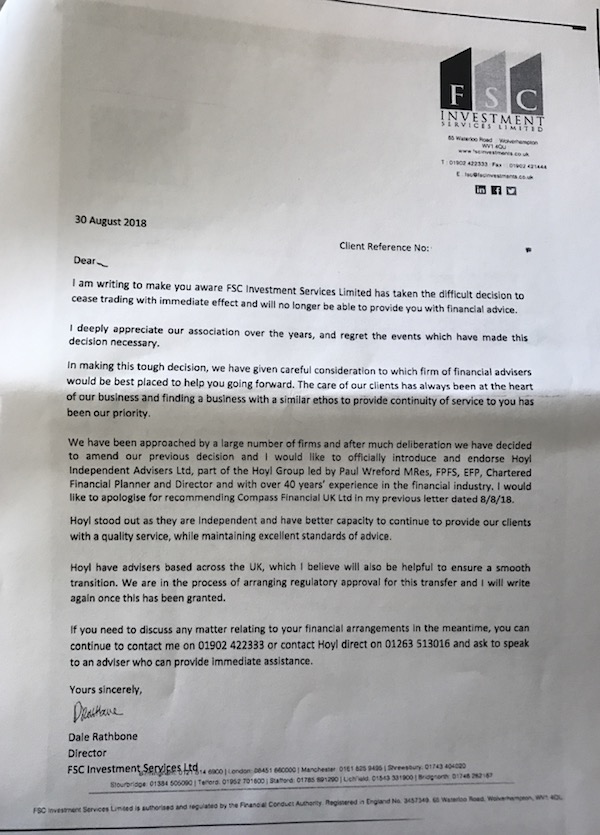
Documents claiming the firm, FSC Investment Services, had ceased trading and staff had been made redundant, were leaked to Financial Planning Today.
The letters, which cannot be confirmed to be genuine, were sent to us last week.
Attempts to speak to the firm’s then director, Dale Rathbone, who was listed as a “trainee IFA” on Companies House files, had proved unsuccessful as Ms Rathbone did not return a number of calls from Financial Planning Today.
{loadposition hidden2}
Now records have been updated to show that Frank Cochran himself has been listed as the active director of the company.
Of the leaked letters, one seemingly addressed to a client was dated 30 August and apparently signed by Ms Rathbone, read: “I am writing to make you aware FSC Investment Services has taken the difficult decision to cease trading with immediate effect and will no longer be able to provide you with financial advice.”

Another was in the form of a photo of a computer screen and believed to have been sent to staff.
The correspondence, dated 17 August, read: “Further to discussions today, I am writing to confirm that FSC Investment Services limited (“the Company”) has decided to make you redundant.
“As you know, several discussions had taken place on the 19th, 20th and 23rd July, at that meeting, the Company confirmed to you that following the changes in personnel and subsequent loss of continuing revenue, other factors out of our control, the Company was considering winding up its activities which may result in the staff being made redundant.”
Financial Planning Today previously revealed how the Midlands-based firm had appointed Ms Rathbone as director, following the resignation of Blair Dunsmuir who, according to Companies House documents, had his positions as director and secretary terminated on 3 July.
In the official documentation, submitted by Ms Rathbone to Companies House, she listed her business occupation as “marketing consultant trainee IFA.”
Fresh files on the Companies House website, received on 5 September and added to the website yesterday, revealed that Ms Rathbone’s position was terminated on 30 August and, on the same day, Frank Cochran was named as director.

The firm’s address was also switched from Church Eaton, in Staffordshire to Waterloo Road, in Wolverhampton, on 26 July, which was a previous address for the firm a month before.
FCA directions ordered the firm to cease all regulated activity in July although it remains ‘authorised,’ according to the FCA register.
At the time of Mr Cochran’s sentencing the firm employed 13 people.
The company’s formerly high-profile founder and majority shareholder, Frank Cochran, was jailed for seven years in April after being found guilty of a string of offences, including sexual assault by penetration, using controlling and coercive behaviour and putting a person in fear of violence by harassment.
He also previously pleaded guilty to owning a Taser stun-gun he bought on holiday in Florida.
Mr Cochran served a large number of affluent clients during his career, including celebrities and professional footballers.
He had also featured on TV interviews with Sky, ITV and CNN and was publicising seminars until months before his imprisonment.
{loadmodule mod_acymailing,Daily Newsletter Sign-up}
]]>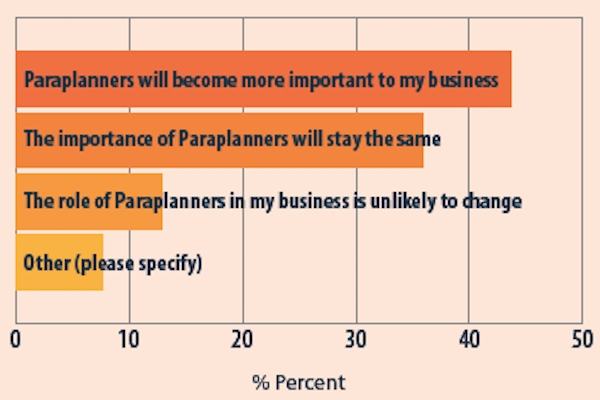
The role of Paraplanners is set to take on greater importance in the next three years, according to a recent survey.
More than 40% of respondents to Financial Planning Today’s recent State of the Financial Planning Profession survey, which features on the latest edition of Financial Planning Today magazine, said the role of Paraplanners would grow in importance to their business in the coming years.
The figure rose from last year’s survey result, from less than 40% to 43.6% this year.
Close to 36% said their importance would remain the same.
The survey also revealed that the vast majority of firms (87.2%) had at least one Paraplanner, with 46.1% employing between two and five.
{loadposition hidden2}
Just over 10% had six to 10 Paraplanners and more than 5% employed more than 10.
Last year 18% of firms employed no Paraplanner at all with that figure dropping to just under 13% this year.
Dan Atkinson FPFS MCSI APP Chartered Financial Planner, head of technical at EQ Investors in London, welcomed the results of the survey.
He said: “These are encouraging stats.
“I’m not surprised to see so many firms sharing that Paraplanners are an important and growing part of their business.
“It lets planners focus on client relationships and provides them with a valuable sounding board.
“It’s great to see so many respondents looking to increase their number of Paraplanners.
“Given the key role that Paraplanners play in many businesses, whether they are employed directly or work on an outsourced basis, this shows that the future remains bright for Paraplanning.
“It’s a vibrant and attractive career path and the next big step is to encourage new entrants to make this their first career in Financial Planning.”
Mr Atkinson’s sentiments were echoed by Chloe Moran, senior Paraplanner at 1825, who said: “It’s great to see such positivity about Paraplanning in the numbers.
“Paraplanning has definitely evolved as a career and it’s clear the industry is stable and growing.”
She added: “Paraplanning is crucial for the future sustainability of Financial Planning, it’s a good route for individuals to take before becoming a Financial Planner, if they wish to pursue that route, and a way to ensure fresh, young blood is entering the industry.”
Ms Moran did sound a note of caution and said technological advances like report writing software could hit Paraplanning, but she said it would be “a challenge to replace the knowledge and skill of a Paraplanner in terms of problem solving, questioning and long term cashflow planning.”
She said she also expects Paraplanning to become “more of a recognised career path for school leavers and graduates” in the near future.
The success of the CISI Paraplanner Conference in June highlighted the strength of the sector, with 120 attendees turning out for the two-day event in Hinckley, Leicestershire.
At the event Aleksandra Sasin, chief Paraplanner at Navigatus, delivered a personal perspective on the sector entitled ‘How Paraplanning has changed my life and lets me do what I love - helping clients get the right outcomes.’
She highlighted the varied role of a Paraplanner and how they can make a difference to the lives of clients.
Financial Planning Today has also reported on firms boosting Paraplanning recently.
The full survey results appear in the latest issue of Financial Planning Today magazine.

{loadmodule mod_acymailing,Daily Newsletter Sign-up}
]]>
The passive fund industry has grown strongly over the last decade or so as investors have increasingly sought out lower-cost solutions and, in the case of the UK, due to the Retail Distribution Review.
This growth has been particularly strong on the exchange traded side and shows no signs of slowing. But what opportunities do passive funds offer Financial Planners and their high net worth / mass affluent clients and are there some less heralded advantages that have gone under the radar.
Patrick Norwood, a Chartered Financial Analyst at Defaqto, addresses these questions, as he explores the most important aspects of passive investing. He also examines how the market has changed in the last few years and how he foresees it evolving in the short to medium term?
Mr Norwood takes a look at the key differences between active and passive investing, along with the advantages and disadvantages of each within a portfolio.
He explains how he assesses different types of passive funds, either exchange traded or more traditional OEIC/unit trust structures and looks at other key issues surrounding passive funds.
Actively seeking out the opportunities passive funds offer Financial Planners and their high net worth clients
The opportunities passive funds offer Financial Planners and their high net worth / mass affluent clients are firstly, a very low risk of underperforming the benchmark, and secondly, generally lower fees.
There is another, possibly less discussed, advantage of passive investing. Financial Planners will often provide future projections for their clients, for example, how large a portfolio might be at some point in the future if the client invests a certain regular amount of money per month into it. The models for these projections will use forecasts for the market, or index, returns and volatility of the asset classes invested in.
Therefore, passive funds will have the same (or virtually the same) risk-return characteristics as those in the models producing the projections, while active funds will have, to varying degrees, different risk-reward characteristics from those of the model.
Thus using passive funds enables a planner to stay closer to the projections of their asset allocation or risk tool. As I will show, the passive fund industry has grown strongly over the last decade or so as investors have increasingly sought out lower-cost solutions and, in the case of the UK, due to the Retail Distribution Review. This growth has been particularly strong on the exchange traded side and shows no signs of slowing.
The main disadvantage of passive investing that Financial Planners need to be aware of is that the investor will forgo potential outperformance over the benchmark, also known as ‘alpha’.
In these times of lower investment returns, a few extra per cent of return each year can make a significant difference over time.
Table 1 shows the two different kinds of passive investment along with the advantages and disadvantages of each.

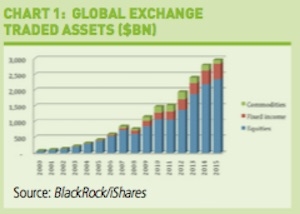
As can be seen from Chart 1 below, after 15 years of almost uninterrupted growth, global exchange traded assets, at the end of 2015, stood at nearly $3tn. As the chart shows, the majority of these assets are in equities.

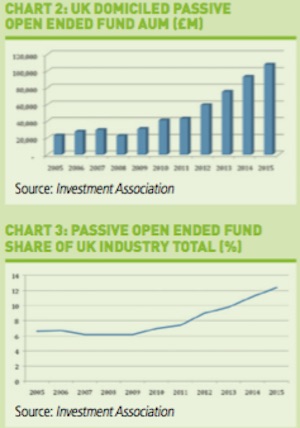
Just over half of the equity total is composed of US equities. Within commodities, half the assets under management (AUM) relate to gold. Turning now to open ended passive funds, the following charts show recent numbers for UK domiciled funds, both in terms of AUM and industry share. As can be seen, there has also been growth in this area, with the passive open ended fund share of total UK funds now standing at more than 12.4 per cent, compared to 6.6 per cent 10 years ago.
In parallel, the last few years have seen a big shift away from synthetic to full and partial replication, at least in the UK. This is most likely due to the fear by many planners of the counterparty risk associated with the synthetic method.
How do we at Defaqto assess and rate passive funds? Firstly we split the universe by asset class and whether the fund is an ETF or an OEIC/unit trust, so that we are comparing like with like when rating each fund.
Within each of these sub-universes the funds are ranked and scored on the following:
• Ability to track, that is how well the fund has met its objective – we use ‘r-squared’, which measures the correlation between the returns of the fund and its respective index, over both 1- and 3-year periods
• Ongoing charges
number of distribution partners (OEICs and
• Unit trusts only) – a key plus for any fund is being available through many platforms
• Fund size – it is generally accepted that most funds are not particularly profitable or comfortably sustainable until they reach a certain size
• Group AUM – gives an indication of scale and resources
• Return on any stock lending for funds that hold physical securities
• Counterparty risk for funds that engage in synthetic replication
• UCITS compliance and domicile – a key plus for any fund today is having UCITS status, because it gives investors some assurance that certain regulatory and investor protection requirements have been met
These are added up to give an overall Diamond Rating, with 5 indicating the best quintile in that market and 1 the worst. When totalling the individual scores, the above factors are weighted such that they have the following effects on the Diamond Rating:
Risk includes counterparty risk, UCITS compliance and domicile. Accessibility is repre- sented by number of distribution partners.
We always keep an eye on market develop- ments and regulatory influences and may sometimes update our rating criteria in order to remain up-to-date. The following numbers and trends within the data used for our 2016 Diamond Ratings may be of interest to Financial Planners. Firstly, passive investments’ ability to track is now generally very good, especially in the case of ETFs.
The average r-squared is around 95 per cent for the traditional passive funds covered by us and more than 99 per cent for the ETFs in our universe (a number of 100 per cent would indicate perfect tracking of the index). In the case of open ended, the one sector where we have seen several funds failing to track their index is non-UK Fixed Income.
The other numbers, which might be of interest to planners, are the latest passive ongoing charges by asset class.
The ETF figures are what might be expected by most people: equity ETFs have higher charges then fixed income ones; within equities the developed market ETFs have similar charges to each other and lower than those of emerging markets; and within fixed income, gilt ETFs have lower charges than corporate bond ones and UK bond ETFs cost less than non-UK ones.

The numbers for traditional passive funds, however, are maybe less expected: more variation among the developed equity market sectors; UK equity funds costing the same as Emerging Market ones on average; and passive gilt funds appearing very expensive in relation to the other asset classes. One reason for this is more outliers in terms of charges within open ended passive funds.
Financial Planners can of course include both active and passive investments in a client’s portfolio. Many people believe that some markets, such as US equities, are very efficient and already highly researched by fund managers and analysts. Therefore, passive management might be best for that part of a portfolio, as it is harder for a manager to add any further value. Emerging markets, however, are less efficient and researched, offering more scope for active management in that area.
Other studies, though, have shown that high proportions of active managers of less ‘efficient’ asset classes have underperformed their benchmark, with there being a greater percentage of underperforming managers than for the more efficient classes.
The less efficient classes will generally have higher fees than the more efficient ones. For example, emerging market equity funds will often be more expensive than US or UK equity funds on average, while high yield bond funds normally cost more than investment-grade bond funds. Therefore, on a gross basis, the manager of the less efficient and more expensive asset class starts ‘further behind’ the index, which means that they will have to beat the index by a greater amount just to break even.
Whichever of the above competing thoughts one believes in, there may be occasions when it makes sense for planners to design portfolios holding both active and passive within the same asset class. When using active managers, investors face a relatively wide distribution of returns. When combining an active fund with a passive fund for that asset class, however, then the distribution of potential returns will be dampened – there will be fewer very low return outcomes, but also fewer outcomes of very high returns.
This reduction in the distribution of returns should reduce ‘client risk’ – the chance of clients leaving if their returns fall below a certain level. In summary, the advantages of passive investing include lower costs on average, virtually no manager risk (the ability of passive funds to track their respective index is generally now very good) and enabling a Financial Planner to stay closer to the projections of their asset allocation or risk tool; while the main advantage of active investing is the potential ability to achieve outperformance over the benchmark.
Passive investments don’t always have to replace their active equivalents though – indeed, it is often sensible for portfolios to contain both active and passive investments.
Within passive, funds can have either exchange traded or more traditional open-ended structures and invest via full, part or synthetic replication. The choice of active versus passive, fund structure and investment method will depend on issues such as:
• The planner’s belief as to whether or not good active managers exist for that asset class
• The client’s attitude to cost
whether intra-day liquidity is important whether the planner and client can tolerate
• The counterparty risk associated with synthetic investments
Among the different passive peer groups there have often been variations in charges and other fund attributes, therefore initial due diligence and ongoing review are very important. Defaqto’s Diamond Ratings can act as a framework for research into passive funds, comparing and rating them across a range of criteria and allowing Financial Planners – and their clients – to see where they sit in the market in terms of quality.